BFUHS Nursing Officer Syllabus and Exam Pattern 2026
Plan your BFUHS Nursing Officer preparation with subject priorities, previous-paper trends and syllabus guidance. Check the latest recruitment notice.
Official links are listed below.
Looking for the BFUHS Nursing Officer syllabus 2026? This guide covers the main nursing subjects, exam-pattern guidance and a practical revision plan. Baba Farid University of Health Sciences (BFUHS), Faridkot conducts nursing recruitment examinations; always confirm the requirements for your post in its official notice.
The examination pattern can vary between recruitment cycles. Check the official BFUHS recruitment notices for the final exam pattern, eligibility criteria, syllabus and selection process.
This BFUHS Nursing Officer syllabus 2026 guide uses previous-paper trends to help you plan revision. It covers the main nursing subjects and study priorities; it is not an official fixed question distribution.
BFUHS Nursing Officer / Staff Nurse Exam Pattern 2026
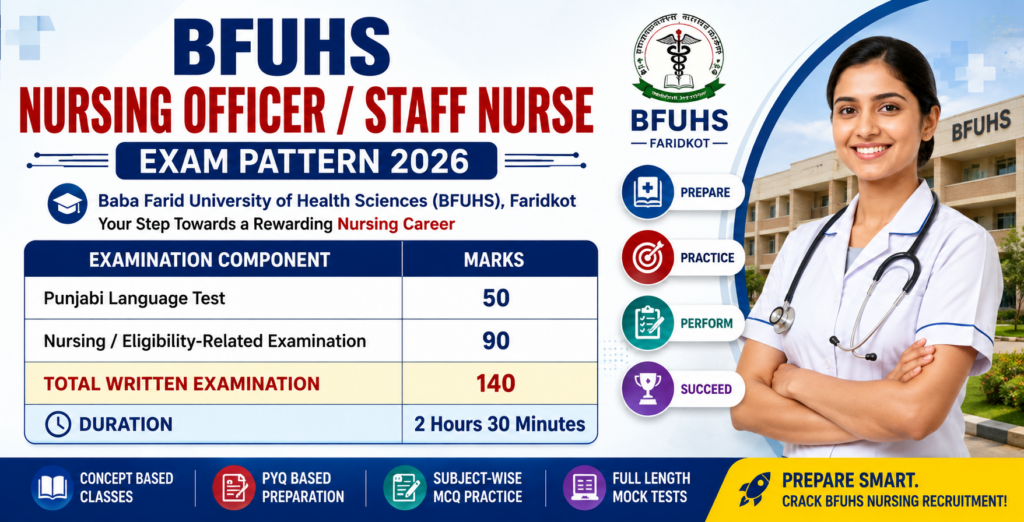
Based on the recent BFUHS recruitment pattern and available examination trends, the written examination may include the following components:
| Examination Component | Marks |
|---|---|
| Punjabi Language Test | 50 |
| Nursing / Eligibility-Related Examination | 90 |
| Total Written Examination | 140 |
| Duration | 2 Hours 30 Minutes |
Important: Candidates should verify the exact marks, duration, qualifying requirements, and other conditions from the latest official BFUHS notification before appearing for the examination.
Punjabi Language Test
The Punjabi Language Test is a qualifying component applicable to certain Punjab Group-C recruitment examinations.
Candidates should prepare Punjabi separately rather than leaving it for the final stage of preparation.
Nursing / Eligibility-Related Examination
The 90-mark nursing examination is the major subject-specific component for nursing candidates. Preparation should cover the core nursing curriculum, clinical concepts, procedures, pharmacology, patient safety, and priority-based nursing interventions.
BFUHS does not necessarily prescribe a fixed chapter-wise distribution of questions. Therefore, the subject priorities below should be treated as a preparation guide based on previous examination trends and available question papers, not as an official chapter-wise blueprint.
BFUHS Nursing Officer Syllabus 2026: Important Subjects
The BFUHS Nursing Officer / Staff Nurse syllabus requires broad coverage of the nursing curriculum. Candidates should give additional attention to subjects that commonly form the foundation of nursing recruitment examinations.
1. Medical-Surgical Nursing
Highest Priority
Medical-Surgical Nursing is one of the most important areas for BFUHS nursing exam preparation.
Focus on:
- Cardiovascular disorders
- Respiratory disorders
- Neurological disorders
- Diabetes mellitus and endocrine disorders
- Renal disorders and dialysis
- Gastrointestinal and liver disorders
- Oncology and cancer nursing
- Burns and trauma
- Shock and sepsis
- Emergency and critical care nursing
- Perioperative nursing
- Fluid and electrolyte balance
- Acid-base balance
- Common medical and surgical conditions
- Postoperative complications
- Pain management
- Patient monitoring and nursing interventions
How to Prepare
Focus not only on disease definitions but also on signs and symptoms, investigations, complications, treatment, nursing management, emergency interventions, and priority nursing actions.
Questions may be framed around situations such as:
- What should the nurse do first?
- Which finding requires immediate attention?
- Which intervention should be performed?
- Which complication should the nurse monitor for?
2. Fundamentals of Nursing
Fundamentals of Nursing provides the foundation for many clinical and application-based questions.
Important Topics
- Nursing process
- Nursing assessment
- Vital signs
- Basic nursing procedures
- Infection prevention and control
- Hand hygiene
- Personal protective equipment (PPE)
- Sterilization and disinfection
- Medication administration
- IV therapy
- Oxygen therapy
- Catheterization
- Nasogastric tube insertion and care
- Suctioning
- Pressure injury prevention
- Patient safety
- Documentation and reporting
- Therapeutic communication
- Delegation
- Prioritization
- BLS and CPR
- Patient positioning
- Specimen collection
- Intake and output
- Safety precautions
Special Focus
Give particular attention to first action, priority intervention, patient safety, delegation, infection control, and clinical decision-making.
These concepts are highly useful for solving application-based nursing MCQs.
3. Midwifery & Gynaecological Nursing
Obstetric and gynaecological nursing is another important area for nursing recruitment examinations.
Important Topics
- Antenatal care
- High-risk pregnancy
- Pre-eclampsia
- Eclampsia
- Stages of labour
- Partograph
- Fetal monitoring
- Postpartum haemorrhage (PPH)
- Placenta previa
- Abruptio placentae
- Obstetric emergencies
- Postnatal care
- Breastfeeding
- APGAR score
- Neonatal resuscitation
- Prematurity
- Low birth weight
- Contraceptive methods
- Family planning
- Common gynaecological disorders
- Normal and abnormal labour
- Maternal complications
High-Yield Areas
Pay special attention to PPH, eclampsia, fetal distress, stages of labour, APGAR, neonatal resuscitation, and obstetric emergencies.
4. Pediatric Nursing
Pediatric nursing requires a strong understanding of normal growth as well as common childhood diseases and emergencies.
Important Topics
- Growth and development
- Developmental milestones
- Newborn care
- Prematurity
- Low birth weight
- Immunization
- Neonatal resuscitation
- Neonatal jaundice
- Neonatal sepsis
- Pediatric dehydration
- Respiratory disorders
- Congenital heart disease
- Pediatric emergencies
- IMNCI
- Childhood infections
- Nutrition and malnutrition
- Fluid and electrolyte management
Candidates should memorize important developmental milestones, immunization concepts, emergency interventions, and age-specific nursing care.
5. Community Health Nursing
Community Health Nursing is an important component of the nursing curriculum and should not be neglected during BFUHS preparation.
Important Topics
- Primary health care
- Principles of primary health care
- Epidemiology
- Screening
- Surveillance
- Immunization
- Communicable diseases
- Tuberculosis
- HIV/AIDS
- Non-communicable diseases
- Maternal and child health
- Family planning
- School health
- Occupational health
- Environmental sanitation
- Health education
- National Health Programmes
- Health indicators
- Community assessment
- Levels of prevention
- Primary, secondary and tertiary prevention
Preparation Tip
Revise important national health programmes, epidemiological concepts, prevention levels, health indicators, immunization, and community health nursing responsibilities.
6. Psychiatric Nursing
Psychiatric Nursing can provide scoring opportunities when concepts are understood clearly.
Important Topics
- Therapeutic communication
- Mental Status Examination
- Schizophrenia
- Depression
- Bipolar disorder
- Mania
- Anxiety disorders
- Obsessive-Compulsive Disorder (OCD)
- Substance-use disorders
- Alcohol withdrawal
- Suicide prevention
- Psychiatric emergencies
- Electroconvulsive Therapy (ECT)
- Psychiatric medications
- Crisis intervention
- Defense mechanisms
- Common psychiatric symptoms
- Nurse-patient relationship
High-Yield Areas
Give additional attention to therapeutic communication, psychiatric emergencies, suicide risk, schizophrenia, mood disorders, alcohol withdrawal, ECT, and psychiatric medications.
7. Anatomy, Physiology & Pharmacology
Anatomy & Physiology
Candidates should revise the normal structure and functioning of major body systems.
Important areas include:
- Cardiovascular system
- Respiratory system
- Nervous system
- Endocrine system
- Renal system
- Reproductive system
- Digestive system
- Acid-base balance
- Electrolytes
- Hormones
- Normal laboratory values
Understanding normal physiology makes it easier to solve Medical-Surgical Nursing questions.
Pharmacology
Important pharmacology topics include:
- Drug classifications
- Mechanisms and major uses of drugs
- Side effects
- Contraindications
- Insulin
- Anticoagulants
- Antibiotics
- Antihypertensive drugs
- Diuretics
- CNS drugs
- Emergency drugs
- Antidotes
- Drug interactions
- Medication safety
- Drug calculations
- Routes of drug administration
Pay special attention to common emergency drugs, important adverse effects, contraindications, antidotes, and medication calculations.
8. Other Important Nursing Subjects
Candidates should also revise the following areas:
- Nursing Management
- First Aid
- Emergency Nursing
- Nutrition
- Health Education
- Microbiology
- Pathology
- Personal Hygiene
- Environmental Hygiene
- Nursing Informatics
- Computers
- Basic Psychology
- Sociology
Although these areas may receive less preparation time than the major nursing subjects, they should be included in the overall revision plan.
Punjabi Language Test Syllabus
Candidates preparing for applicable Punjabi Language Tests should prepare the language section separately.
Important Punjabi Topics
- Punjabi grammar
- Vocabulary
- Synonyms
- Antonyms
- Sentence correction
- Idioms and phrases
- Comprehension
- Spelling
- Punjab history
- Punjab culture
- Important personalities
- Important places
Regular practice is recommended because the Punjabi component can be qualifying in nature, depending on the recruitment notification.
What Do BFUHS Previous Papers Suggest?
Previous BFUHS-related question papers and available examination trends indicate that candidates should prepare the entire nursing curriculum rather than relying on one or two subjects.
Important recurring areas include:
- Medical-Surgical Nursing
- Fundamentals of Nursing
- Midwifery and Gynaecological Nursing
- Pediatric Nursing
- Community Health Nursing
- Psychiatric Nursing
- Pharmacology
- Anatomy and Physiology
Candidates should also expect questions based on clinical application, nursing procedures, medication knowledge, patient safety, prioritization, and emergency interventions.
Therefore, simply memorizing textbook definitions may not be enough. Candidates should practise applying their knowledge to clinical situations.
BFUHS Nursing Officer Preparation Strategy 2026
A structured preparation strategy can help you cover the BFUHS Nursing Officer syllabus 2026 without leaving revision until the last week. Keep a subject checklist, practise questions regularly and review the topics you find difficult.

Illustrative study photo by Kyle Gregory Devaras on Unsplash.
Use the checklist below to organise your study sessions.
1. Start With High-Priority Subjects
Begin your preparation with:
Medical-Surgical Nursing → Fundamentals of Nursing → OBG Nursing → Pediatric Nursing → Community Health Nursing → Psychiatric Nursing
After completing these subjects, move towards Pharmacology, Anatomy & Physiology and other supporting subjects.
2. Practise Previous-Year Questions
Previous-year questions are useful for understanding:
- Frequently tested concepts
- Question difficulty
- Clinical application
- Repeated topics
- Common distractors
- Exam-oriented facts
Do not simply memorize the answer. Understand why the correct option is correct and why the other options are incorrect.
3. Focus on Clinical Application
BFUHS nursing preparation should include application-based MCQs.
Practise questions such as:
- What should the nurse do first?
- Which patient requires immediate attention?
- Which intervention is most appropriate?
- Which finding should be reported immediately?
- Which patient should be assessed first?
- Which medication requires special monitoring?
- What is the priority nursing intervention?
This approach improves both conceptual understanding and exam performance.
4. Prepare Punjabi Separately
Do not postpone Punjabi preparation until the final week.
Set aside regular time for:
- Grammar
- Vocabulary
- Comprehension
- Synonyms and antonyms
- Idioms
- Spelling
- Punjab-related general knowledge
Consistent practice can improve speed and accuracy.
5. Take Full-Length Mock Tests
Mock tests help candidates develop:
- Time management
- Question-selection skills
- Accuracy
- Exam temperament
- Speed
- Revision strategy
After every mock test, analyse your mistakes and identify weak topics.
Suggested BFUHS Nursing Study Priority
A practical subject priority for preparation is:
| Priority | Subject |
| 🔴 Very High | Medical-Surgical Nursing |
| 🔴 Very High | Fundamentals of Nursing |
| 🔴 Very High | Midwifery & Gynaecological Nursing |
| 🟠 High | Pediatric Nursing |
| 🟠 High | Community Health Nursing |
| 🟠 High | Psychiatric Nursing |
| 🟡 Moderate | Anatomy & Physiology |
| 🟡 Moderate | Pharmacology |
| 🟢 Supporting | Nursing Management, Nutrition, Microbiology, Pathology, Psychology, Sociology, Informatics |
This priority is intended to guide preparation and does not represent an official BFUHS question distribution.
BFUHS Nursing Preparation at Kanika’s Nursing Academy
At Kanika’s Nursing Academy, BFUHS Nursing Officer / Staff Nurse preparation is designed around the requirements of competitive nursing examinations.
Our preparation approach includes:
✔️ Concept-based nursing classes
✔️ Previous-year question-based preparation
✔️ Subject-wise MCQ practice
✔️ Clinical and priority-based questions
✔️ Punjabi language preparation
✔️ Full-length mock tests
✔️ Detailed explanations
✔️ Rapid revision
✔️ Exam-focused strategy
Prepare Smart. Practise PYQs. Crack BFUHS Nursing Recruitment.
If you are preparing for the BFUHS Nursing Officer / Staff Nurse Recruitment Exam 2026, structured preparation, regular MCQ practice, and consistent revision can help you approach the examination with greater confidence.
Join Kanika’s Nursing Academy for focused BFUHS Nursing Officer / Staff Nurse preparation.
[JOIN BFUHS NURSING PREPARATION]
Frequently Asked Questions About BFUHS Nursing Exam 2026
What is the BFUHS Nursing Officer / Staff Nurse exam pattern?
Based on recent recruitment patterns, the examination may include a Punjabi Language Test of 50 marks and a Nursing/eligibility-related examination of 90 marks, for a total of 140 marks. Candidates should verify the final pattern from the latest official BFUHS notification.
How many marks is the Nursing examination?
The Nursing/eligibility-related examination has been described as 90 marks in the recent pattern used as the basis for this preparation guide.
Is the Punjabi Language Test qualifying?
The Punjabi Language Test is a qualifying component for applicable Punjab Group-C recruitments. The exact qualifying criteria should be checked in the relevant recruitment notification.
Which subject is most important for BFUHS Nursing preparation?
Medical-Surgical Nursing and Fundamentals of Nursing should receive strong priority, followed by Midwifery & Gynaecological Nursing, Pediatric Nursing, Community Health Nursing, and Psychiatric Nursing.
Does BFUHS have a fixed chapter-wise syllabus?
Candidates should not assume a fixed chapter-wise distribution unless it is specifically provided in the official recruitment notification. The priorities in this guide are based on available examination trends and previous questions.
Are previous-year questions important for BFUHS Nursing exams?
Yes. PYQs can help candidates understand recurring concepts, question styles, clinical applications, and areas that deserve additional revision.
How should I prepare for the BFUHS Nursing Officer exam?
Start with the high-priority nursing subjects, strengthen your concepts, practise PYQs and MCQs, revise pharmacology and clinical procedures, prepare Punjabi separately, and take regular full-length mock tests.
Final Preparation Advice
The BFUHS Nursing Officer / Staff Nurse examination requires broad nursing knowledge combined with clinical reasoning and speed.
Instead of preparing only through memorization, focus on:
Concepts + Clinical Application + PYQs + MCQs + Revision + Mock Tests
Give extra attention to priority-based nursing questions, emergency care, medication safety, infection control, patient assessment, and common clinical conditions.
Most importantly, always follow the latest official BFUHS recruitment notification for the final examination pattern, eligibility requirements, syllabus, qualifying criteria, and selection process.
Disclaimer
This syllabus and preparation guide has been prepared by Kanika’s Nursing Academy as a PYQ-based and exam-oriented preparation resource using available BFUHS recruitment patterns and previous question-paper trends.
The subject-wise priorities and topic lists provided above are indicative and should not be considered an official fixed BFUHS blueprint or guaranteed question distribution.
Candidates are advised to refer to the latest official BFUHS recruitment notification for the final examination pattern, eligibility criteria, syllabus, qualifying requirements, and other recruitment conditions.
BFUHS previous-paper practice and preparation support
Start with the Download the official BFUHS Staff Nurse paper – 12 April 2026, including the readable Punjabi section. Use the official revised answer key instead of the earlier key included in the paper. Practise the nursing questions in Set 1: questions 51–100 and Set 2: questions 101–140. For guided preparation, explore our nursing coaching courses or contact the academy.
Important official links
Always verify dates, fees, and eligibility on the recruiting organization’s official website.
Get new nursing vacancies in your inbox.
Subscribe once and confirm your email. We will notify you when a new nursing job or examination update is published.