NORCET-11 2026 Exam Pattern & Syllabus
NORCET-11 (Nursing Officer Recruitment Common Eligibility Test) is one of the most competitive nursing recruitment examinations conducted by AIIMS, New Delhi, for Nursing Officer posts. With the recent NORCET examinations showing an increasing emphasis on clinical application, case scenarios, prioritisation and nursing judgement, aspirants preparing for NORCET-11 should focus not only on memorising nursing facts […]
Official links are listed below.
NORCET-11 (Nursing Officer Recruitment Common Eligibility Test) is one of the most competitive nursing recruitment examinations conducted by AIIMS, New Delhi, for Nursing Officer posts.
With the recent NORCET examinations showing an increasing emphasis on clinical application, case scenarios, prioritisation and nursing judgement, aspirants preparing for NORCET-11 should focus not only on memorising nursing facts but also on understanding how to apply them in clinical situations.
This NORCET-11 exam pattern and syllabus guide has been prepared by Kanika’s Nursing Academy by analysing recent NORCET question-paper trends and high-yield topics. It should be used as a preparation guide; candidates should always refer to the latest official AIIMS notification for the final examination scheme.
NORCET-11 Exam Pattern
NORCET follows a two-stage examination process:
Stage I – NORCET Preliminary Examination
Stage II – NORCET Mains Examination
The recent AIIMS NORCET framework uses a CBT-based Stage I and Stage II, with Stage II being the decisive clinical nursing examination. The NORCET-10 official notification scheduled Stage I for 11 April 2026 and Stage II for 30 April 2026.
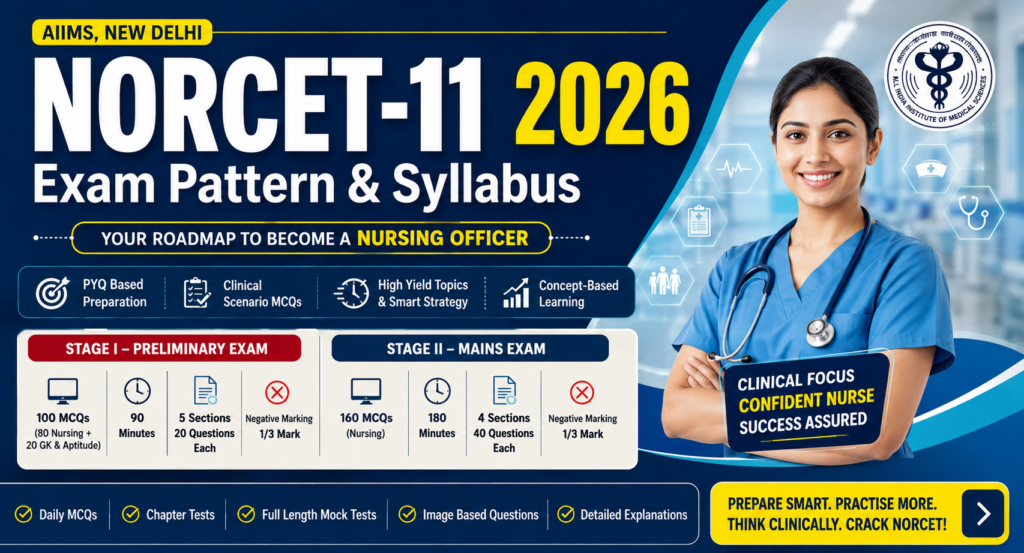
Stage I – Preliminary Examination
Particular Details
Mode Computer-Based Test (CBT)
Total Questions 100 MCQs
Total Marks 100
Duration 90 Minutes
Nursing 80 Questions
General Knowledge & Aptitude 20 Questions
Negative Marking 1/3 mark for each wrong answer
Sections 5
Questions per Section 20
Sectional Time 18 minutes
What is important for Stage I?
Stage I is primarily a screening/qualifying examination. Candidates need strong nursing fundamentals, adequate speed and good accuracy.
The 80-question Nursing component should receive the majority of preparation time, while the 20-question General Knowledge & Aptitude component should be covered strategically.
Stage II – NORCET Mains Examination
Particular Details
Mode Computer-Based Test
Total Questions 160 MCQs
Total Marks 160
Duration 180 Minutes
Subject Nursing
Negative Marking 1/3 mark for each wrong answer
Sections 4
Questions per Section 40
Sectional Time 45 minutes
Question Style Clinical / Case-scenario based
The Mains examination is especially important for final merit and places much greater emphasis on clinical nursing competency and decision-making.
Recent NORCET-10 Mains analysis found a strong concentration of questions from Medical-Surgical Nursing, OBG, Paediatrics and Community Health Nursing, with a substantial proportion of clinical scenario-based questions.
NORCET-11 Expected Subject-Wise Weightage
AIIMS does not prescribe a fixed chapter-wise question distribution. Therefore, the following is an expected preparation weightage based on recent NORCET trends, and should not be treated as an official AIIMS blueprint.
Subject Expected Priority
Medical-Surgical Nursing 🔴 Very High
Fundamentals of Nursing 🔴 Very High
OBG & Midwifery 🔴 Very High
Pediatric Nursing 🔴 High
Psychiatric Nursing 🔴 High
Community Health Nursing 🟠 High
Pharmacology 🟠 High
Anatomy & Physiology 🟡 Moderate
Nursing Administration 🟡 Moderate
Research & Statistics 🟡 Moderate
Nutrition 🟢 Supporting
Microbiology / Pathology / Genetics 🟢 Supporting
Psychology / Sociology 🟢 Supporting
Recent NORCET-9 analysis reported 24 questions from Medical-Surgical Nursing and substantial representation from Fundamentals, OBG, Paediatrics, Psychiatry and Community Health. NORCET-10 analysis again identified MSN as the largest component and highlighted OBG, Psychiatry, Paediatrics and CHN.
NORCET-11 Detailed Syllabus
- Medical-Surgical Nursing
⭐ Highest Priority
Focus on clinical conditions, assessment, complications, nursing management and emergency interventions.
Important Topics
• Cardiovascular disorders
• MI and acute coronary syndrome
• Heart failure
• Hypertension
• Arrhythmias and ECG
• DVT and pulmonary embolism
• Respiratory disorders
• COPD and asthma
• Pneumonia and tuberculosis
• ARDS and respiratory failure
• Mechanical ventilation
• ABG interpretation
• Neurological disorders
• Stroke
• Increased ICP
• GCS
• Seizures
• Head and spinal cord injuries
• Diabetes mellitus
• DKA and HHS
• Thyroid disorders
• AKI and CKD
• Dialysis
• Fluid and electrolyte imbalance
• Acid-base imbalance
• GI disorders
• Liver disease
• Pancreatitis
• GI bleeding
• Oncology nursing
• Burns and trauma
• Shock and sepsis
• Critical care
• Perioperative nursing
Recent NORCET-10 Mains analysis identified respiratory, cardiac, endocrine and renal nursing among important MSN areas.
- Fundamentals of Nursing
Important Topics
• Nursing process
• Nursing assessment
• Nursing diagnosis
• Vital signs
• Physical examination
• Infection prevention and control
• Standard precautions
• Isolation precautions
• Hand hygiene
• PPE
• Sterilisation and disinfection
• Biomedical waste management
• Medication administration
• IV therapy
• Fluid balance
• Catheterisation
• NG tube
• Suctioning
• Oxygen therapy
• Pressure injury prevention
• Patient safety
• Documentation
• Therapeutic communication
• Delegation
• Prioritisation
• BLS and emergency nursing procedures
Special Focus
Prepare extensively for:
“What should the nurse do first?”
“Which patient should the nurse attend to first?”
“Which finding requires immediate intervention?”
“Which action is most appropriate?”
- Obstetrics & Midwifery
High-Yield Topics
• Antenatal care
• High-risk pregnancy
• Pre-eclampsia and eclampsia
• Gestational diabetes
• Rh incompatibility
• Stages of labour
• Mechanism of labour
• Partograph
• Fetal monitoring and CTG
• Induction of labour
• Postpartum haemorrhage
• Placenta previa
• Abruptio placentae
• Cord prolapse
• Uterine rupture
• Puerperium
• Breastfeeding
• Postnatal complications
• APGAR
• Neonatal resuscitation
• Prematurity
• Low birth weight
• Neonatal jaundice and sepsis
• Contraception
Recent PYQ analyses repeatedly identify labour, pre-eclampsia, contraception and high-risk obstetric situations as important areas.
- Pediatric Nursing
Important Topics
• Growth and development
• Developmental milestones
• Newborn care
• Prematurity and LBW
• Breastfeeding
• Immunisation
• Neonatal resuscitation
• Neonatal jaundice
• Neonatal sepsis
• Pediatric dehydration
• Diarrhoea
• Respiratory disorders
• Congenital heart disease
• Common childhood illnesses
• Pediatric emergencies
• IMNCI
• Pediatric medication calculations
Growth and development, neonatal care and pediatric respiratory conditions have remained important areas in recent analyses.
- Psychiatric Nursing
Important Topics
• Therapeutic communication
• Mental status examination
• Schizophrenia
• Depression
• Bipolar disorder
• Mania
• Anxiety disorders
• OCD
• Personality disorders
• Substance-use disorders
• Alcohol withdrawal
• Delirium tremens
• Suicide risk and prevention
• Crisis intervention
• Psychiatric emergencies
• ECT
• Psychotherapies
• Psychiatric medications
Special focus: therapeutic communication, suicide assessment, psychiatric emergencies and appropriate nursing interventions.
- Community Health Nursing
Important Topics
• Primary health care
• Community assessment
• Epidemiology
• Incidence and prevalence
• Screening
• Surveillance
• Immunisation
• Communicable diseases
• TB and HIV/AIDS
• Non-communicable diseases
• Maternal and child health
• Family planning
• School health
• Occupational health
• Environmental sanitation
• Water purification
• Health education
• National Health Programmes
• Health indicators
• Demography
• Home visits
Recent papers have also included health data, biomedical waste, national programmes and current guideline-based questions, making updated CHN preparation increasingly important.
- Pharmacology
Do not prepare Pharmacology by memorising drug names alone.
For every important drug/class, know:
Classification → Mechanism → Indication → Side Effects → Contraindications → Antidote → Nursing Responsibilities
High-Yield Areas
• Insulin
• Antidiabetic drugs
• Anticoagulants
• Antiplatelets
• Thrombolytics
• Antihypertensives
• Diuretics
• Antibiotics
• Antiepileptics
• Antipsychotics
• Antidepressants
• Steroids
• Emergency drugs
• Drug interactions
• Adverse drug reactions
• High-alert medications
• Drug calculations
- Anatomy & Physiology
Focus particularly on applied physiology:
• Cardiovascular system
• Respiratory system
• Nervous system
• Endocrine system
• Renal system
• GI system
• Reproductive system
• Blood and lymphatic system
• Cardiac cycle
• Respiratory physiology
• Renal physiology
• Acid-base balance
• Electrolytes
• Hormones
• Cranial nerves
• Autonomic nervous system
• Normal laboratory values
- Nursing Research & Statistics
Important areas include:
• Research process
• Research designs
• Variables
• Sampling
• Data collection
• Reliability and validity
• Bias
• Evidence-based practice
• Mean, median and mode
• Standard deviation
• Correlation
• p-value
• Interpretation of research findings
- Nursing Administration & Management
• Leadership
• Management principles
• Staffing
• Delegation
• Supervision
• Scheduling
• Nursing audit
• Quality assurance
• Patient safety
• Inventory management
• Records and reports
• Conflict management
• Disaster management
- Supporting Nursing Subjects
Candidates should also revise:
Nutrition
• Balanced diet
• Therapeutic diets
• Nutritional assessment
• Deficiency disorders
• Enteral and parenteral nutrition
Microbiology
• Microorganisms
• Infection transmission
• Sterilisation
• Disinfection
• Immunity
• Hospital-acquired infections
Pathology
• Cell injury
• Inflammation
• Neoplasia
• Blood disorders
• Major system pathology
Psychology & Sociology
• Learning
• Memory
• Personality
• Motivation
• Stress and coping
• Family
• Culture
• Socialisation
• Social problems
Genetics
• Chromosomes
• Genetic disorders
• Inheritance
• Genetic counselling
General Knowledge & Aptitude – Stage I
The 20-question non-nursing component should be prepared separately.
General Knowledge
• Current affairs
• Indian polity
• Indian Constitution
• History
• Geography
• General science
• Health-related current affairs
• Government health schemes
• Important days
• Awards
• Sports
• Books and authors
• Important organisations
Aptitude & Reasoning
• Number system
• Percentage
• Ratio and proportion
• Average
• Profit and loss
• Time and work
• Time, speed and distance
• Simple and compound interest
• Data interpretation
• Number series
• Coding-decoding
• Analogy
• Classification
• Blood relations
• Direction sense
• Logical reasoning
What Type of Questions Should You Expect in NORCET-11?
The biggest change aspirants should understand is the movement from simple recall to clinical application.
Recent NORCET-10 analysis reported a strong presence of case-scenario questions, with clinical decision-making and applied knowledge playing a major role. The Mains analysis similarly reported that approximately 45% of analysed questions were clinical scenario-based.
Therefore, prepare for:
🩺 Clinical Scenario Questions
A patient is presented with signs and symptoms and you must identify the appropriate nursing action.
🚨 Priority Questions
• Who should be seen first?
• What should the nurse do first?
• Which intervention has priority?
💊 Medication Questions
• Side effects
• Antidotes
• Contraindications
• Nursing responsibilities
• Drug interactions
🖼️ Image-Based Questions
Be prepared for images related to:
• ECG
• X-rays
• Instruments
• Clinical signs
• Charts and monitoring equipment
📋 Case-Based Questions
A patient scenario may contain several findings, requiring you to identify the diagnosis, priority problem, intervention or expected outcome.
NORCET-11 Preparation Strategy
- Build Strong Concepts
Do not rely entirely on one-line notes. Understand the why behind the nursing intervention. - Study High-Weightage Subjects First
Prioritise:
MSN → OBG → Paediatrics → Psychiatry → CHN → Fundamentals
Then strengthen Pharmacology, Anatomy & Physiology and the remaining subjects. - Solve Previous-Year Questions
PYQs should be used to identify:
• Repeated concepts
• Frequently tested topics
• Question framing
• Clinical application
• Distractor patterns - Practise Clinical Reasoning
For every topic ask:
What is the problem?
What is the priority?
What should the nurse do first?
What should be avoided?
What indicates deterioration? - Practise With Time Limits
Because of sectional timing, candidates should practise both speed and accuracy, rather than solving unlimited untimed MCQs. - Revise Current Guidelines
Pay particular attention to updated areas such as:
• Biomedical Waste Management
• Immunisation
• National Health Programmes
• Diabetes management
• Infection control
• Consent
• Emergency care
• Current health statistics
Recent NORCET-10 analysis reported questions involving updated health data, biomedical waste rules, consent and clinical guidelines.
NORCET-11 Success Formula
CONCEPT → APPLICATION → PRIORITISATION → PRACTICE → REVISION
NORCET preparation is no longer just about remembering more facts.
The goal is to develop the ability to think like a Nursing Officer in a clinical situation.
Why Choose Kanika’s Nursing Academy for NORCET Preparation?
At Kanika’s Nursing Academy, NORCET preparation focuses on both knowledge and clinical application.
Our NORCET preparation includes:
✔️ Concept-based Nursing Classes
✔️ PYQ-oriented preparation
✔️ Clinical scenario-based MCQs
✔️ High-yield topic revision
✔️ Priority and delegation questions
✔️ Image-based questions
✔️ Daily MCQ practice
✔️ Sectional tests
✔️ Full-length NORCET mock tests
✔️ Detailed explanations
✔️ Performance analysis
✔️ Rapid revision sessions
Prepare Smart. Practise More. Think Clinically. Crack NORCET.
Join Kanika’s Nursing Academy’s NORCET-11 Nursing Officer Preparation Programme and prepare with a focused, PYQ-based and clinically oriented strategy.
[JOIN NORCET-11 PREPARATION]
Frequently Asked Questions
- What is the NORCET-11 exam pattern?
NORCET follows a two-stage examination process consisting of Stage I Preliminary Examination and Stage II Mains Examination. Stage I includes Nursing along with General Knowledge/Aptitude, while Stage II focuses on Nursing and clinical competency. - Is there a separate official chapter-wise NORCET-11 syllabus?
AIIMS does not generally provide a guaranteed chapter-wise question distribution. The syllabus is based broadly on the nursing curriculum corresponding to the prescribed qualification. The detailed topic list above is a PYQ-based preparation guide prepared by Kanika’s Nursing Academy. - Which subject is most important for NORCET-11?
Medical-Surgical Nursing should receive the highest priority, followed by OBG, Paediatrics, Psychiatry, Community Health Nursing and Fundamentals. - Are NORCET questions becoming more clinical?
Yes. Recent NORCET analyses indicate an increasing emphasis on case scenarios, clinical application, prioritisation and nursing judgement. - Should I study PYQs for NORCET-11?
Absolutely. PYQs help identify recurring concepts, question patterns and high-yield areas. However, candidates should understand the concept behind each question rather than memorising answers. - Is General Knowledge important for NORCET?
Yes. General Knowledge and Aptitude form part of the Stage I preparation and should be covered strategically without compromising Nursing preparation.
Disclaimer
This NORCET-11 syllabus and preparation blueprint has been prepared by Kanika’s Nursing Academy using recent NORCET examination trends and available previous-paper analyses. The subject-wise priorities and expected distribution are indicative and not an official AIIMS question blueprint. Candidates should refer to the latest official AIIMS notification for the final examination pattern, dates, eligibility requirements and other instructions.
Official AIIMS Examination Portal: urlAIIMS Examination Sectionhttps://www.aiimsexams.ac.in/
Important official links
Always verify dates, fees, and eligibility on the recruiting organization’s official website.
Get new nursing vacancies in your inbox.
Subscribe once and confirm your email. We will notify you when a new nursing job or examination update is published.