BFUHS PMNET 2026 M.Sc Nursing: Eligibility, Exam Pattern, Fees & Admission
1. What is PMNET-2026? PMNET-2026 is the Punjab Master of Sciences (Nursing) Entrance Test conducted by Baba Farid University of Health Sciences, Faridkot, for admission to M.Sc. Nursing courses for session 2026. The prospectus is divided into: The University states that PMNET-2026 is being conducted to select suitable candidates for Nursing Colleges in Punjab, with […]
Official links are listed below.
The application deadline listed on this page has passed. Check the official source for results, counselling or subsequent notices.
1. What is PMNET-2026?
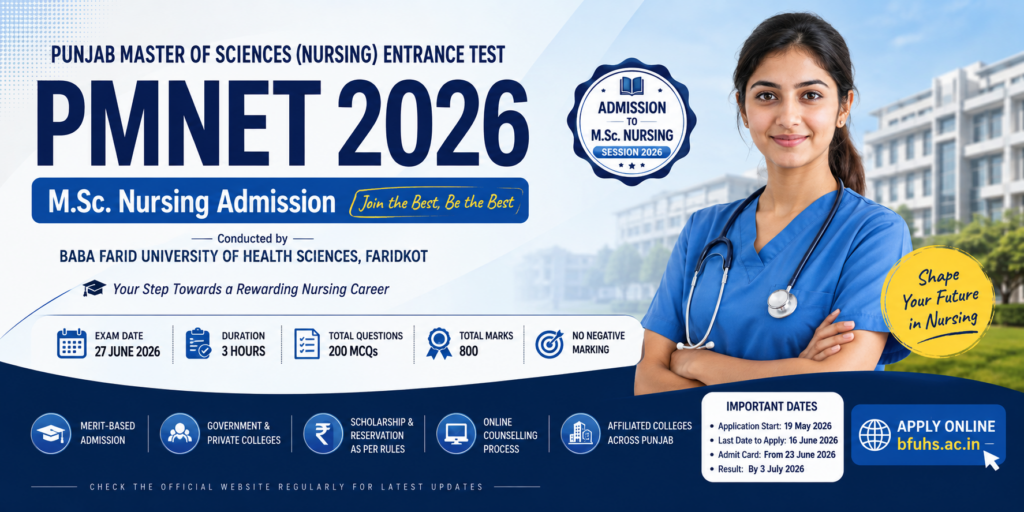
PMNET-2026 is the Punjab Master of Sciences (Nursing) Entrance Test conducted by Baba Farid University of Health Sciences, Faridkot, for admission to M.Sc. Nursing courses for session 2026.
The prospectus is divided into:
- Part I: Application process, entrance examination, OMR instructions, result, merit and counselling.
- Part II: Punjab Government rules/notification governing eligibility, reservation, fees and admission.
The University states that PMNET-2026 is being conducted to select suitable candidates for Nursing Colleges in Punjab, with selection intended to be merit-based and transparent.
2. Important dates for PMNET-2026
According to the prospectus:
| Event | Date |
|---|---|
| Prospectus available | 19 May 2026 onwards |
| Last date for online application | 16 June 2026 |
| Last date for application-fee payment | 17 June 2026 |
| Correction in application | Up to 22 June 2026, 5:00 PM |
| Admit-card download | From 23 June 2026 |
| PMNET-2026 examination | 27 June 2026 |
| Last date for objections to question paper | 29 June 2026 |
| Result | By 3 July 2026 |
| NRI/Foreign National application deadline | 6 July 2026, up to office timings |
| Counselling | Schedule to be announced later |
Important: The prospectus says candidates must regularly check the University website because subsequent notifications, amendments or changes can be issued.
3. Application fee
For the PMNET-2026 application:
- General category: ₹5,000 + 18% GST = ₹5,900
- SC candidates: ₹2,500 + 18% GST = ₹2,950
The fee has to be deposited through the University’s online payment gateway. The prospectus states that the application fee, once deposited, is not refundable/adjustable.
Important application rule
Only one application should be submitted by a candidate. Submitting more than one application can result in rejection.
4. Eligibility for M.Sc. Nursing
This is one of the most important sections.
The prospectus specifically refers to Punjab Government Notification No. 5/7/2013-5HB-III/5416 dated 09.09.2020 for eligibility.
Basic qualification
The notification states that the candidate should have obtained a certificate/degree in:
- B.Sc. Nursing, or
- B.Sc. Post Basic Nursing
from an institution recognized by the Punjab Nurses Registration Council (PNRC)/Indian Nursing Council (INC) and situated in Punjab, subject to the exemptions specified in the notification for certain categories/NRI quota.
Minimum marks
The notification’s Note-1 states that candidates should have passed B.Sc. Nursing/B.Sc. Post Basic Nursing with a minimum of 55% marks from BFUHS or an equivalent examination with the requisite percentage prescribed by INC. Where the qualifying examination is from IGNOU/New Delhi, the study centre must be recognized by INC.
Work experience: very important
The notification further states that candidates should have at least one year of work experience at the time of joining the course in:
- a recognized Bedside Nursing position, or
- a Public Health Nursing position, or
- a Nursing Educational Institute recognized by INC,
after B.Sc. Nursing or before/after Post Basic B.Sc. Nursing as specified in the notification.
So, based strictly on this prospectus, having the qualifying nursing degree alone is not sufficient; the one-year experience requirement is also important.
5. Punjab residence requirement
The notification says that a candidate should generally be a bona fide resident of Punjab, with resident status determined according to the Punjab Government’s applicable instructions.
However, the notification specifically lists categories that are eligible despite the general residence requirement, including:
- Wards of defence personnel posted in Punjab.
- Candidates seeking admission under NRI category.
- Candidates belonging to a minority community competing for minority quota.
- Certain children/wards/dependents of Central Government employees and employees of Central Government Boards/Corporations/Statutory Bodies under the conditions specified.
- Candidates under J&K migrant quota for J&K migrant quota seats.
Therefore, Punjab domicile/residence is important, but there are specified exemptions.
6. Minimum entrance-test score
The Punjab Government notification specifies:
- General: minimum 40% in the entrance test.
- SC/BC: minimum 35% in the entrance test.
This is a minimum eligibility threshold, not necessarily the score needed to actually obtain a preferred college/specialty. Actual admission depends on merit, eligibility, category and available seats.
7. PMNET-2026 examination pattern
This is clearly specified in the prospectus.
Examination
- Duration: 3 hours
- Total questions: 200 MCQs
- Total marks: 800
- Mode: Objective/MCQ
- Answer sheet: OMR
Distribution
| Subject | Questions | Marks |
|---|---|---|
| Nursing | 180 | 720 |
| General Knowledge / Trends in Nursing | 20 | 80 |
| Total | 200 | 800 |
That means:
1 question = 4 marks.
The syllabus is based on the B.Sc. Nursing / Post Basic B.Sc. Nursing syllabus prescribed by BFUHS.
Practical implication
The examination is overwhelmingly nursing-focused:
- 90% of questions are Nursing.
- 10% are General Knowledge/Trends in Nursing.
So preparation should be heavily concentrated on the B.Sc./Post Basic B.Sc. Nursing curriculum.
8. Negative marking: important clarification
There is no negative marking for an incorrect answer.
However, there is a special rule for an unattempted question.
Each question has:
A | B | C | D | E
If you do not know the answer, you should mark E.
If you leave all five ovals blank, the prospectus says 1 mark will be deducted for that question.
Therefore:
Wrong answer → no negative marking.
Unattempted + E marked → no negative marking.
All five options blank → −1 mark.
This is an important exam strategy point.
9. OMR rules
The OMR instructions are strict.
You must:
- Use a BLACK FINE TIP BALL PEN.
- Completely darken the selected oval.
- Mark only one oval for each question.
- Avoid stray marks.
- Do not fold, soil or mutilate the OMR sheet.
- Do not do rough work on the OMR sheet.
- Rough work can be done on the question booklet.
If more than one oval is darkened, the response is treated as wrong. A faint/lightly marked oval may also be rejected by the optical scanner.
The prospectus also provides a sample OMR sheet on page 18, showing 200 questions and five options A–E.
10. Examination-day rules
Candidates must:
- Report to the examination centre by 8:00 AM for biometric verification.
- Not enter the examination centre after 10:30 AM.
- Carry the admit card.
- Carry one original valid government-issued photo ID, such as:
- PAN card
- Driving licence
- Voter ID
- Passport
- Aadhaar with photograph.
Photocopies or photographs/scans of IDs on a mobile phone are not accepted as valid ID proof.
Things not allowed
The prospectus prohibits items such as:
- Mobile phones
- Electronic devices
- Calculators
- Slide rules
- Log tables
- Electronic watches with calculator functions
- Printed/written material
Candidates are also not allowed to leave the examination hall before the full examination time has elapsed.
11. Admit card
The admit card is not sent by post.
Candidates must download it from the University website according to the schedule. It will contain the examination date/time/venue information.
The prospectus states that the admit card is issued only after receipt of the application fee. If the fee has been deposited but the admit card is not available, the candidate has to contact the University personally before the specified deadline with proof of fee payment.
12. Result and merit
The OMR sheets are evaluated by an OMR machine.
The result is prepared:
- Rank-wise
- Roll-number-wise
- Category-wise
The University does not issue physical result cards. Candidates download their result cards online.
Important distinction
The prospectus says the PMNET ranking itself is based solely on the entrance-test result and is initially an indication of relative position. Admission eligibility and final seat allocation additionally depend on the Punjab Government notification and applicable rules.
13. Tie-breaking rules
If candidates obtain equal marks, the notification gives the following order:
- Candidate with the higher aggregate percentage up to three decimal places.
- If still equal, candidate with the higher percentage in the final year B.Sc. Nursing/B.Sc. Post Basic Nursing up to three decimal places.
- If still equal, the older candidate gets preference.
14. Reservation
For Government/University colleges, the notification specifies reservation including:
| Category | Reservation |
|---|---|
| Scheduled Caste | 25% |
| Backward Classes | 10% |
| Differently Abled | 5% |
For private institutes, the notification also lists:
- Scheduled Caste: 25%
- Backward Classes: 10%
- Differently Abled: 5%
subject to the applicable rules and availability of seats.
There are additional rules concerning the operation of reservations, including the treatment of reserved candidates selected in the general category and conversion of vacant reserved seats.
15. NRI seats
The notification provides for:
- 7.5% of seats in Government/University institutions for NRI candidates.
- 15% of seats in private institutions for NRI candidates.
The notification describes two broad NRI categories:
- Category I: NRI/children of NRI who originally belong to Punjab.
- Category II: NRI/children of NRI who originally belong to an Indian state other than Punjab.
The prospectus separately states that NRI and Foreign National candidates do not have to appear in the entrance test and must obtain the required eligibility certificate and apply according to the prescribed process.
16. NRI fee
The prospectus specifies the M.Sc. Nursing NRI fee as:
US $11,000 total
with the option described as:
- First instalment at admission:US $6,000
- Second instalment after one year:US $5,000
A bank guarantee/surety bond is required for the residual fee if the instalment option is used.
The prospectus also lists separate charges for eligibility/equivalency certification and NRI application processing.
17. Tuition fee
The Punjab Government fee notification reproduced in the prospectus states:
Government institutions
₹1,00,000 per year
Private institutions
₹1,75,000 per year for Indian nationals
NRI/Foreign National
US $11,000 for the full course in the fee notification reproduced there.
The prospectus specifically cautions that these figures are subject to subsequent Punjab Government notifications/amendments applicable to the 2026 session.
There is therefore an important distinction between the application fee of ₹5,900/₹2,950 and the course tuition fee payable after selection.
18. HSLIBNET fee
Students admitted to M.Sc. Nursing are required to pay a one-time HSLIBNET fee of ₹3,000, collected along with tuition fee at admission.
19. Working candidates
The prospectus contains an important rule for candidates who are already employed.
A candidate getting admission while working in an institute must provide a relieving certificate from the employer at the time of joining.
If it is subsequently found that the student continues employment after admission, the candidate may be debarred from pursuing M.Sc. Nursing and action may be taken under University rules.
20. Counselling process
Counselling is conducted online after declaration of the PMNET-2026 result.
Candidates submit:
- College preferences
- Category preferences
- Other applicable choices
through the University website.
Seats are allocated according to:
PMNET merit + eligibility + candidate’s preference/choice + seat availability.
After seat allotment
The candidate must:
- Download the provisional allotment letter.
- Report to the allotted college.
- Complete medical check-up where applicable.
- Have original documents verified.
- Have eligibility checked.
- Deposit the required fee.
- Complete joining.
A provisional allotment does not automatically guarantee the seat. The seat remains subject to document and eligibility verification.
21. Upgradation in counselling
If you are satisfied with your first-round seat, you don’t need to participate in subsequent rounds.
If you want to:
- Change college
- Upgrade college
- Change subject/category/quota
you need to participate in the subsequent counselling and submit fresh choices.
An interesting rule is that during the second round, candidates may enter choices even for colleges/categories that aren’t currently showing vacancies, because seats can become available through upgrades, shifting and conversion. Allocation remains subject to merit and availability.
22. College and seat information
There is an important limitation in the 2026 prospectus.
The prospectus says that the Indian Nursing Council/PNRC/Punjab Government had not yet uploaded the final list of M.Sc. Nursing colleges and intake for 2026 when the prospectus was prepared.
Therefore:
The final college-wise seat/intake list will be published on the University website at the time of online counselling.
So you should not rely on an old college/seat list to predict the 2026 intake.
Special Badal seat
The prospectus states that one M.Sc. Nursing seat at State Institute of Nursing and Paramedical Sciences, Badal, District Muktsar Sahib, is reserved for residents of Village Badal. If not filled by an eligible Village Badal resident, it will be filled from the open quota.
23. Colleges provisionally listed as girls-only
The final page gives a provisional list of affiliated Nursing colleges permitted to admit only girls for 2026:
- Guru Hargobind College of Nursing, Raikot, Ludhiana
- Mai Bhago College of Nursing, Village Piddi, District Tarn Taran
- Mata Sahib Kaur College of Nursing, VPO Balongi, District Mohali
- MHR DAV Institute of Nursing, Jalandhar
- Rattan Professional Education College, Sohana, Mohali
- SGL College of Nursing, Jalandhar
- Shri Guru Ram Das College of Nursing, Hoshiarpur
This is described as provisional, so candidates should check the final counselling information.
24. Documents and application precautions
The prospectus tells candidates to retain:
- At least three printouts of the submitted online application.
- Proof of fee payment.
- Three copies of the latest identical coloured photograph.
The photograph must:
- Be taken after 01-01-2026.
- Be passport size.
- Have a white background.
- Not show a cap or goggles.
- Be clear and acceptable to the University’s requirements.
Polaroid/computer-generated photographs are not acceptable.
The online application also requires accurate bank-account details and upload of a cancelled cheque/passbook copy for refund-related purposes.
25. Category selection is very important
The candidate has to select the appropriate category code in the application.
The prospectus lists, among others:
- General:11
- Scheduled Caste:12
- Backward Classes:13
- Physically Disabled:14
The prospectus strongly warns that a category claim must be made correctly. No reservation benefit is given if the category isn’t claimed in the online application.
The correction window is available up to 22 June 2026, after which changes are not permitted under the stated rule.
26. Overall selection process
The entire process can be understood as:
Eligibility → Online Application → Fee Payment → Admit Card → PMNET-2026 → Result/Rank → Online Counselling → Choice Filling → Seat Allocation → Document Verification → Fee Payment → Joining
The selection itself is based on entrance-examination merit, subject to the applicable Punjab Government eligibility, reservation and admission rules.
Important official links
Always verify dates, fees and eligibility on the relevant examination or admission authority’s official website.
Get new nursing vacancies in your inbox.
Subscribe once and confirm your email. We will notify you when a new nursing job or examination update is published.