AIIMS B.Sc. Nursing (Post-Basic) 2026
AIIMS B.Sc. Nursing (Post-Basic) 2026 — Detailed Information 1. Course overview 2. Eligibility For B.Sc. Nursing (Post-Basic), the prospectus specifies that the candidate must have: Special provision for male nurses For male nurses who passed before implementation of the new integrated course in 2003, the prospectus gives an additional requirement: besides State Nursing Council registration, […]
Official links are listed below.
AIIMS B.Sc. Nursing (Post-Basic) 2026 — Detailed Information
1. Course overview
- Course: B.Sc. Nursing (Post-Basic)
- Institute: AIIMS New Delhi
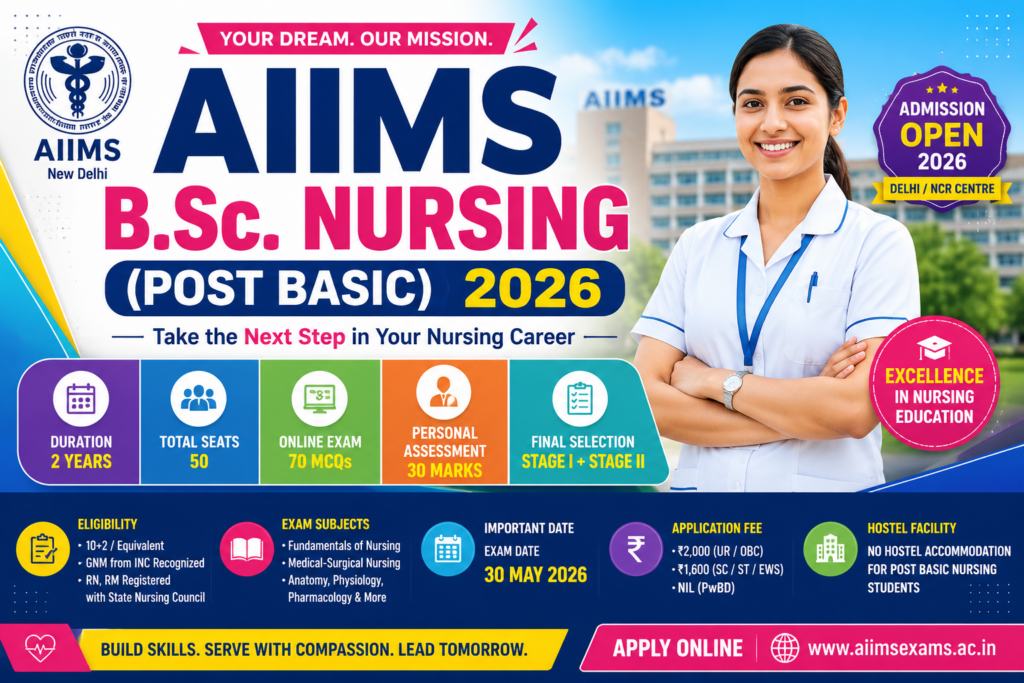
- Duration: 2 years.
- The prospectus describes the objective of the Post-Basic programme as training nurses to provide comprehensive nursing care contributing to the health of individuals, families and communities through preventive, promotive, curative and restorative healthcare. It also aims to develop basic nursing management and teaching skills, communication, leadership and decision-making abilities.
2. Eligibility
For B.Sc. Nursing (Post-Basic), the prospectus specifies that the candidate must have:
- Passed 12th class under the 10+2 system, or an equivalent examination from a recognised Board/University.
- Candidates who passed 10+1 on or before 1986 are also eligible.
- Diploma in General Nursing and Midwifery (GNM) from an institution recognised by the Indian Nursing Council.
- Registration as a Nurse, RN, RM — Registered Nurse and Registered Midwife — with a State Nursing Council.
Special provision for male nurses
For male nurses who passed before implementation of the new integrated course in 2003, the prospectus gives an additional requirement: besides State Nursing Council registration, they should have a General Nursing certificate and six months’ training in one of the specified areas, such as OT Techniques, Ophthalmic Nursing, TB Nursing, Psychiatric Nursing, Neurological/Neurosurgical Nursing, Community Health Nursing, Cancer Nursing or Orthopaedic Nursing.
Important point about age
The general admission section says a candidate must have attained or will attain 17 years by 31 December 2026, with candidates born on or after 2 January 2010 being ineligible.
The prospectus does not state a separate upper-age limit for B.Sc. Nursing (Post-Basic) in the section I reviewed.
3. Number of seats
This is one of the most important points.
For AIIMS New Delhi B.Sc. Nursing (Post-Basic), the prospectus shows:
| Category of seat | Total |
|---|---|
| Outside candidates | 30 |
| AIIMS departmental candidates | 20 |
| Total seats | 50 |
The departmental seats are specifically described as non-transferable for open admission. PwBD reservations are earmarked against the relevant categories.
So, if you are not an AIIMS departmental candidate, the relevant pool is the 30 outside-candidate seats.
4. Entrance examination
The Post-Basic Nursing entrance examination is different from the B.Sc. (Hons.) Nursing examination.
Examination details
- Mode: Online
- Centre: Delhi/NCR only
- Language: English only
- Duration: 90 minutes
- Questions: 70 objective-type MCQs
- Selection is conducted in two stages.
Stage I — Written test
The 70 questions cover:
- Fundamentals of Nursing
- Medical-Surgical Nursing
- including Anatomy
- Physiology
- Pharmacology
- Obstetrics Nursing & Midwifery
- Paediatric Nursing
- Community Health Nursing
- Psychiatric Nursing
- Professional Trends in Nursing
Very important
The prospectus states that no specific syllabus has been prescribed by the Institute and that the general standard of the entrance examination is based on the 10+2 level/equivalent standard. For Post-Basic Nursing, however, the prospectus explicitly identifies the nursing subjects listed above.
So for preparation, you should treat the listed GNM/nursing subjects as the core syllabus, rather than preparing it like the B.Sc. (Hons.) Nursing PCB entrance.
5. Negative marking
The entrance examination has negative marking:
| Response | Marks |
|---|---|
| Correct | +1 |
| Incorrect | −1/3 |
| Not answered | 0 |
| Marked for Review* | 0 |
The prospectus specifically says a question marked for review is treated as unanswered unless it is saved. More than one response is negatively marked.
Maximum theoretical written-test score
70 questions × 1 mark = 70 marks.
6. Stage II — Personal Assessment / Interview
This is extremely important for Post-Basic Nursing.
After Stage I:
- A merit list is prepared based on the written-test performance.
- Candidates approximately three times the number of available seats are invited for Personal Assessment.
- A Selection Committee conducts the Personal Assessment.
- Personal Assessment carries 30 marks.
Since there are 50 total seats, three times the number would theoretically correspond to about 150 candidates, subject to the category-wise provisions specified by AIIMS.
What is considered during Personal Assessment?
AIIMS specifically states that the following are considered:
- Past academic performance in Higher Secondary/+2 or equivalent
- Past academic performance in the Nursing examination
- Performance as a Staff Nurse
Final selection
Final admission is based on the aggregate marks of Stage I + Stage II.
So the selection is not based only on the written examination.
7. Tie-breaking
If two or more candidates obtain equal combined marks in both stages:
- Higher marks in Written Test (Stage I) are preferred.
- If still tied, the older candidate is preferred.
8. Qualifying cutoff
The prospectus specifies the entrance-test qualifying cutoff for B.Sc. courses as:
| Category | Minimum qualifying marks |
|---|---|
| UR | 50% |
| EWS | 50% |
| OBC | 45% |
| SC | 40% |
| ST | 40% |
This is a qualifying cutoff, not necessarily the marks needed to secure a seat.
Because the Post-Basic programme has only a limited number of seats and final selection incorporates Stage II, the actual competitive score needed can be considerably higher than the minimum qualifying percentage.
9. 2026 important dates
According to the 2026 prospectus:
| Event | Date |
|---|---|
| Online registration starts | 25 March 2026 |
| Last date for registration | 24 April 2026, 5:00 PM |
| Final accepted/rejected status | 29 April 2026 |
| Correction of deficiencies | 29 April–3 May 2026 |
| Post-Basic Nursing admit card | 25 May 2026 — tentative |
| Post-Basic Nursing entrance examination | 30 May 2026, Saturday |
| Expected Stage-I result | 5 June 2026 |
| Personal Assessment/Interview | To be declared later |
| Final result | To be declared |
The prospectus also specifies that the Post-Basic Nursing entrance examination is online and conducted at Delhi/NCR centres only.
10. Application fee
The 2026 prospectus gives the following application/registration fees:
| Category | Fee |
|---|---|
| General/UR | ₹2,000 |
| OBC (NCL) | ₹2,000 |
| SC | ₹1,600 |
| ST | ₹1,600 |
| EWS | ₹1,600 |
| PwBD | Nil |
Transaction charges are applicable where specified. Payment is through credit card, debit card or net banking.
11. Course fees
The institute’s listed fees are surprisingly low compared with many private nursing institutions.
For B.Sc. Nursing (Post-Basic):
| Fee | Amount |
|---|---|
| Registration fee | ₹25 |
| Tuition fee | ₹200 |
| Pot money | ₹480 |
| Hostel rent | ₹240 |
| Caution money | ₹100 |
| Hostel security | ₹1,000 refundable |
The prospectus says the fees are subject to revision by the Institute.
Important hostel point
Although the fee table contains a hostel-rent figure for Post-Basic Nursing, the Hostel Accommodation section specifically says:
No hostel accommodation will be provided to B.Sc. (Post Basic) Nursing students.
Therefore, you should not assume hostel availability simply because a hostel-rent amount appears in the fee table.
12. Mess
The prospectus says mess is compulsory for nursing students residing in hostels, with the listed mess charge of ₹700/month, subject to revision.
Since Post-Basic Nursing students are specifically stated to receive no hostel accommodation, this hostel-mess provision would not automatically apply to them.
13. Medical examination
Candidates selected for admission must undergo a medical examination by an AIIMS-appointed Medical Board.
If the Board finds a candidate medically unfit, the candidate will not be admitted and the next candidate in merit may be considered.
14. Documents and joining
At admission, candidates have to bring the relevant certificates/documents in original.
The prospectus states that the original documents will be retained by the institute until completion of the course.
Candidates confirming a seat must also undergo biometric verification at joining.
A selected candidate who does not join by the stipulated date can lose the seat, and the prospectus states that deposited fees are not refundable in that situation.
15. Leaving the course midway
There is an important financial condition.
If a candidate joins a B.Sc. Nursing (Post-Basic) course and leaves it midway, the prospectus states that the candidate is liable to pay ₹5,000 as compensation/losses incurred by AIIMS.
16. Reservation
For participating AIIMS, the general reservation framework stated in the prospectus is:
- OBC: 27%
- SC: 15%
- ST: 7.5%
- EWS: 10%
- PwBD: 5% horizontal reservation for Indian nationals
For AIIMS New Delhi Post-Basic Nursing specifically, the seat table should be used rather than simply applying these percentages mechanically, because it separately identifies outside and departmental seats and category-wise seats.
17. What you should study for the entrance exam
Based strictly on the subjects named in the prospectus, your preparation should concentrate on:
A. Fundamentals of Nursing
- Basic nursing concepts
- Nursing process
- Vital signs
- Hygiene
- Bed making
- Patient safety
- Infection prevention/control
- Basic procedures
- Nutrition
- Elimination
- Medication administration
- First aid/emergency nursing
B. Medical-Surgical Nursing
This is likely to be a major area because the prospectus specifically includes it along with Anatomy, Physiology and Pharmacology.
Focus on:
- Cardiovascular disorders
- Respiratory disorders
- GI disorders
- Renal disorders
- Neurological disorders
- Endocrine disorders
- Blood disorders
- Infectious diseases
- Oncology
- Emergency/critical care
- Perioperative nursing
- Fluid/electrolyte balance
C. Anatomy & Physiology
- Cells and tissues
- Musculoskeletal system
- Cardiovascular system
- Respiratory system
- Digestive system
- Nervous system
- Endocrine system
- Genitourinary system
- Reproductive system
- Special senses
D. Pharmacology
- Drug classifications
- Routes of administration
- Dosage calculations
- Adverse effects
- Drug interactions
- Common antibiotics
- Analgesics
- Cardiovascular drugs
- Respiratory drugs
- CNS drugs
- Emergency drugs
E. Obstetrics & Midwifery
- Antenatal care
- Normal pregnancy
- Labour
- Stages of labour
- Normal delivery
- Complications of pregnancy
- PPH
- PIH/preeclampsia/eclampsia
- Postnatal care
- Newborn care
- Family planning
F. Paediatric Nursing
- Growth and development
- Immunization
- Newborn care
- Common childhood illnesses
- Nutrition
- Pediatric emergencies
- Neonatal problems
G. Community Health Nursing
- Primary healthcare
- Community assessment
- Epidemiology
- National health programmes
- Communicable diseases
- Maternal/child health
- Environmental sanitation
- Health education
- Public-health statistics
H. Psychiatric Nursing
- Mental-health concepts
- Psychiatric disorders
- Schizophrenia
- Mood disorders
- Anxiety disorders
- Substance-use disorders
- Therapeutic communication
- Psychiatric emergencies
- Psychiatric medications
I. Professional Trends in Nursing
- Nursing profession
- Nursing organizations
- Ethics
- Legal aspects
- Nursing administration
- Leadership
- Nursing education
- Research
- Professional responsibilities
Important: The above topic breakdown is a practical study organization based on the subjects explicitly listed by AIIMS; the prospectus itself says that no detailed prescribed syllabus is provided.
18. Most important things to remember
If you are preparing for AIIMS B.Sc. Nursing Post-Basic 2026, these are the points I would put at the top of your notes:
Eligibility
- 10+2/equivalent
- GNM diploma recognized by INC
- RN/RM registration with State Nursing Council
- Check the special provision if applicable to a male nurse.
Exam
- 70 MCQs
- 90 minutes
- English only
- Delhi/NCR
- Nursing-focused subjects
- −1/3 negative marking.
Selection
- Stage I written test
- Approximately 3× seats called for Stage II
- Personal Assessment = 30 marks
- Academic record + nursing performance + staff-nurse performance considered
- Final merit = Stage I + Stage II.
Seats
- 30 outside candidates
- 20 AIIMS departmental
- 50 total.
Duration
- 2 years.
Hostel
- No hostel accommodation for Post-Basic Nursing students.
2026 exam
- 30 May 2026.
Application
- ₹2,000 UR/OBC
- ₹1,600 SC/ST/EWS
- Nil PwBD.
Important official links
Always verify dates, fees, and eligibility on the recruiting organization’s official website.
Get new nursing vacancies in your inbox.
Subscribe once and confirm your email. We will notify you when a new nursing job or examination update is published.