PGIMER Chandigarh Nursing Officer 2026: Exam Pattern & Syllabus
Use this detailed guide with the main syllabusThis guide explains CBT marking and offers practical revision advice. If you need the full subject list first, read the main PGIMER syllabus guide. Check the official notice for your recruitment before using an earlier exam pattern.Main PGIMER syllabus guide · Try six public practice questions · PGIMER […]
Official links are listed below.
Use this detailed guide with the main syllabus
This guide explains CBT marking and offers practical revision advice. If you need the full subject list first, read the main PGIMER syllabus guide. Check the official notice for your recruitment before using an earlier exam pattern.
Main PGIMER syllabus guide · Try six public practice questions · PGIMER coaching and current course details
PGIMER Nursing Officer examination pattern
Use this guide alongside the PGIMER syllabus and preparation overview. The reference pattern below will help you plan practice sessions. Confirm the final rules in the official notice for your recruitment.
How the CBT is organised
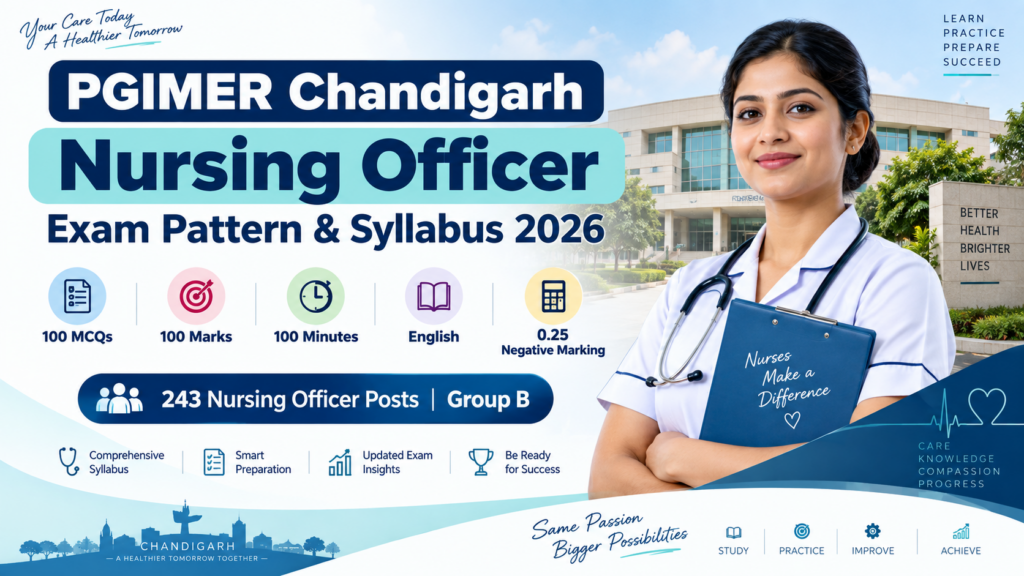
- The Computer Based Test is held online in English.
- There are 100 objective multiple choice questions for 100 marks.
- The duration is 100 minutes, giving an average of one minute per question.
- Each correct answer earns 1 mark. Each wrong answer loses 0.25 marks. An unanswered question scores 0.
- Selection is based on CBT merit and document verification. There is no interview for these Group B posts.
Minimum qualifying marks
The reference pattern specifies 40 marks out of 100 for General and EWS candidates, and 35 for SC, ST and OBC candidates. For PwBD candidates, the minimum follows the applicable parent category. Reserved category candidates applying for an unreserved position must meet the 40% standard.
Reaching the qualifying mark does not guarantee selection. Candidates must also be shortlisted for document verification.
How shortlisting works
The reference shortlisting ratio is three candidates for each advertised vacancy in a category, with candidates tied at the boundary also included. For example, 66 OBC vacancies would give a base shortlist of 3 × 66 = 198 candidates, plus any applicable ties. Being called for document verification is not the same as being selected.
Calculate your practice score
Score = correct answers × 1 − wrong answers × 0.25. Unanswered questions add no marks and carry no penalty.
Avoid guessing without a reason. Read the options carefully and use what you know to rule out unlikely answers. Always follow the marking rules printed on your actual examination instructions.
What happens if scores are tied?
The reference rules apply these checks in order:
- More wrong answers or negative marks result in a lower rank.
- The older candidate ranks higher.
- A higher percentage in 10+2 gives priority.
- A higher percentage in Class 10 gives priority.
PGIMER Nursing Officer syllabus: preparation topics
B.1 What the official syllabus means for your preparation
PGIMER bases the syllabus on the prescribed nursing qualification. It does not provide a fixed allocation of questions for each topic.
Practical meaning : The exam is purely based on Nursing curriculum taught in B.Sc Nursing / Post Basic B.Sc Nursing / GNM (General Nursing & Midwifery) courses. There is no separate portion for General Knowledge, Reasoning or English (unless corrigendum is issued later specifying otherwise). Candidates should check PGIMER’s website for any addendum before the exam.
B.2 Probable Coverage by Topic (Based on a Typical Nursing Curriculum)
Use the nursing subjects below as a revision checklist. They follow the core nursing curriculum and are preparation guidance, not an official allocation of questions by topic.
- The Basics of Nursing
Documentation & nursing process
Monitoring of vital signs
Infection control & asepsis
Personal hygiene and comfort measures
Positioning, movement and body mechanics
Wound Care and Dressing Techniques
Giving medicines (how to give, calculating doses, safety)
Specimen collection
- Anatomy & Physiology
Structure and function of body systems (eg cardiovascular, respiratory, digestive, neurological, musculoskeletal, endocrine, renal, reproductive)
Homeostatic processes
- Medical-Surgical Nursing (Adult Health Nursing)
Disorders nursing management: cardiovascular, respiratory, GI, renal, endocrine e.g. diabetes, neurological, musculoskeletal
Nursing care before and after surgery
Oncology Nursing Fundamentals
Emergency & critical care nursing (ICU/CCU principles, triage)
Fluid and electrolyte balance
- Midwifery (Obstetrics & Gynaecology Nursing)
Antenatal, intranatal and postnatal care
Normal Labour and Delivery Process
Conditions of high-risk pregnancy
Methods of birth control
Gynaecological diseases & nursing care
- Child Nursing (Paediatric Nursing)
Growth & development milestones
National Immunisation Program: immunisation schedule
Nutritional diseases in children
Common paediatric diseases and nursing management
Neonatal care
- Community Health Nursing
National health programmes, including NHM, RCH and programmes for TB, leprosy and malaria
Primary Health Care Strategy (PHCS)
General epidemiology
Environmental sanitation and health education
Maternal and Child Health (MCH) services;
- Mental Health / Psychiatric Nursing
Psychiatric Disorders (anxiety, depression, schizophrenia)
Techniques of Therapeutic Communication
Crisis response
Psychopharmacology 101
- Nursing Foundation, Management & Ethics
Nursing theories and models
Management of Ward/Unit
Ethics in nursing, patient rights and legal aspects
Quality assurance and patient safety
- Nursing Research & Biostatistics
The basic research process
Methods of Sampling
Presentation & Analysis of Data
- Supporting nursing subjects
Microbiology (infection control related)
Pharmacology (drug categories, calculating dosage, negative effects)
Pathology (fundamental disease mechanisms)
Nutrition & Dietetics
PGIMER preparation strategy and practice tests
Practise PGIMER previous papers and mock tests to identify weak topics before your next revision session.
Make each practice session useful
- Revise core nursing subjects using your B.Sc. Nursing or GNM textbooks and class notes.
- Work through PGIMER previous papers and review the explanations after each attempt. Papers from AIIMS or ESIC can offer extra practice, but check their exam rules separately.
- Use a 100 question, 100 minute session to practise the reference timing. Follow the current notice if your exam uses a different scheme.
- Review wrong answers to understand whether you missed a concept, misread the question or guessed too quickly.
Before the exam, check www.pgimer.edu.in for any notice that changes the syllabus or examination rules.
Important official links
Always verify dates, fees and eligibility on the relevant examination or admission authority’s official website.
Get new nursing vacancies in your inbox.
Subscribe once and confirm your email. We will notify you when a new nursing job or examination update is published.