BFUHS PPMET 2026: B.Sc. Nursing Admission in Punjab
Explore PPMET 2026 eligibility, exam pattern, syllabus and counselling for B.Sc. Nursing admission in Punjab, with links to the supplied official resources.
Official links are listed below.
The application deadline listed on this page has passed. Check the official source for results, counselling or subsequent notices.
1. What is PPMET-2026?
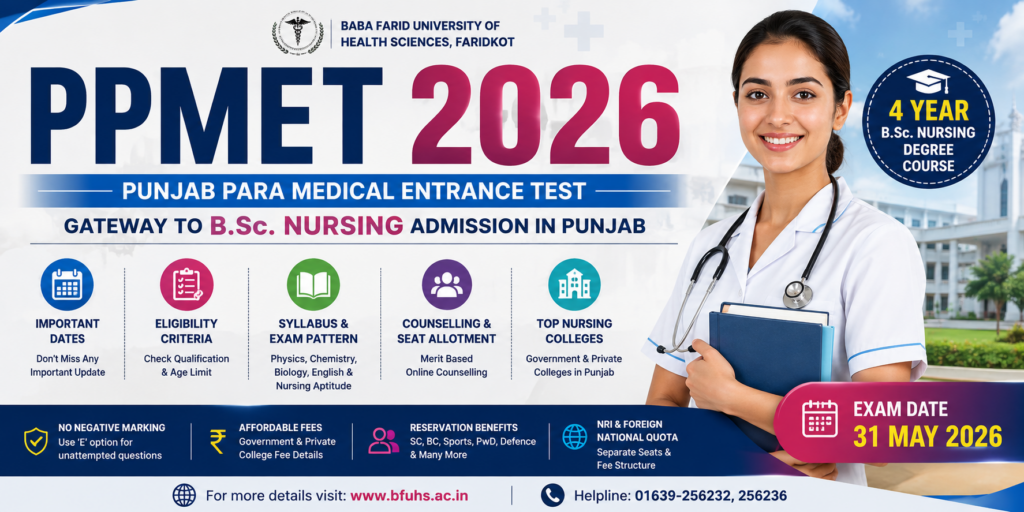
PPMET 2026, the Punjab Para Medical Entrance Test, is conducted by Baba Farid University of Health Sciences (BFUHS), Faridkot for admission to its affiliated four-year B.Sc. Nursing courses in Punjab. Use this guide to understand the application, examination and counselling steps, and check the official notices linked below.
The prospectus is divided into:
- Part I: Application process, examination, OMR rules, result, merit and counselling.
- Part II: Punjab Government rules governing B.Sc. Nursing admission, eligibility, reservation, fees and related matters.
- Annexures: Certificates, undertaking formats, syllabus and tentative college information.
BFUHS states that it has 172 affiliated colleges, including 125 Nursing colleges, along with its constituent colleges.
2. Important dates for PPMET-2026
According to the prospectus:
| Event | Date |
|---|---|
| Prospectus available | 27 April 2026 onwards |
| Last date for online application | 12 May 2026 |
| Last date for fee payment | 13 May 2026, up to 4:00 PM |
| Correction in application | Up to 22 May 2026, 5:00 PM |
| Admit card | 25 May 2026 |
| PPMET-2026 examination | 31 May 2026, Sunday |
| Question-paper objections | 2 June 2026 |
| Expected result | By 5 June 2026 |
| Sports-category document submission | 9 June 2026 |
| NRI/Foreign National application deadline | 9 June 2026 |
| Counselling | Schedule to be announced later |
Important: The prospectus specifically says counselling dates will be announced later on the University website, and subsequent Punjab Government/University notifications will apply.
3. Eligibility: very important
The prospectus refers candidates to the Punjab Government notification for the detailed eligibility requirements. The 2023 notification reproduced in the prospectus says that a candidate must have passed 12th standard (10+2) with Science and obtained:
- Minimum 45% marks in Physics, Chemistry and Biology taken together
- English passed individually
- For SC/ST/OBC, the notification specifies 40% in the relevant qualifying requirement.
The notification states that the PPMET selection is for candidates with Science in the qualifying examination.
Age
The candidate must have completed 17 years on or before 31 December 2026. The prospectus also states that the candidate must have been born on or before 31 December 2009.
So, in simple terms:
For a normal candidate: 10+2 Science + PCB + English + required percentage + minimum age of 17 years.
However, because the prospectus explicitly says that the 2026 Punjab Government admission notification had not yet been issued when the prospectus was prepared, later Government amendments can change the applicable requirements.
4. Punjab domicile / state-quota eligibility
The prospectus contains fairly detailed rules for Punjab state-quota eligibility.
The notification generally requires the candidate to be an Indian citizen and satisfy Punjab-related conditions such as:
- Passing 10+1 and 10+2 from Punjab, or
- Being born in Punjab, or
- Being a permanent resident of Punjab.
The definition of permanent resident includes several special circumstances involving study in Punjab, parents employed by Punjab Government, certain Central Government employees, children of pensioners, and persons who have lived in Punjab for the required period.
The prospectus also lists certain additional eligible groups, including:
- Wards of defence personnel posted in Punjab
- NRI candidates
- Candidates competing for minority-quota seats in minority institutions
- Certain children/wards/dependents of Central Government employees.
Therefore, being from another state does not automatically mean you can never get admission, but the order and category under which you can participate matter.
5. Application fee
For the PPMET-2026 application:
General candidates
- Application fee:₹3,000
- 18% GST:₹540
- Counselling fee:₹1,000
- Total = ₹4,540
SC candidates
- Application fee:₹1,500
- 18% GST:₹270
- Counselling fee:₹1,000
- Total = ₹2,770
The fee has to be paid through the online payment gateway. The prospectus states that the fee is not refundable/adjustable after deposit.
6. How to apply
The application is online only.
The prospectus specifically says:
- Read the prospectus carefully.
- Submit only one application.
- Complete the online form.
- Upload the required documents.
- Upload photograph, signature and thumb impression.
- Pay the fee through the University payment gateway.
- Keep the registration ID and password safe.
- Download and preserve the admit card.
Submitting more than one application can result in rejection.
Photograph requirements
The prospectus requires:
- Latest identical coloured photographs
- Passport-size
- White background
- Taken after 1 January 2026
- No cap or goggles
- Spectacles are permitted if normally used
- Polaroid/computer-generated photographs are not acceptable.
Candidates are advised to keep three copies of the photograph and at least three printouts of the submitted application form.
7. Bank details
A particularly important application requirement is the bank information.
The candidate has to:
- Enter bank-account details accurately.
- Upload a cancelled cheque/copy of passbook.
- Ensure the account details are correct.
The prospectus places responsibility on the candidate for problems caused by incorrect bank details.
8. PPMET-2026 examination pattern
The examination consists of questions from:
- Physics
- Chemistry
- Biology
- English
- Nursing Aptitude
The test is objective/MCQ based.
The question paper provides four normal options:
- A
- B
- C
- D
There is also a fifth OMR option:
- E: used when the candidate does not attempt the question.
Very important: negative marking
There is no negative marking for an incorrect answer.
However, there is a special rule:
If you leave all five OMR ovals blank, 1 mark is deducted.
Therefore, if you don’t know an answer, you should mark E rather than leaving the question completely blank.
This is one of the most important rules in the entire prospectus.
Example
Suppose you don’t know Question 50.
❌ Leave A/B/C/D/E all blank → −1 mark
✅ Mark E → no negative marking
❌ Mark A and B together → response treated as wrong.
9. OMR rules
The OMR sheet must be completed using only a black fine-tip ball pen.
The candidate must carefully fill:
- Name
- Roll number
- Question booklet number
- Signature
- Other required booklet/OMR information.
The OMR sheet is optically scanned. A partially or lightly filled oval may be rejected by the scanner.
Do not:
- Fold the OMR sheet
- Make stray marks
- Darken multiple options
- Write rough work on the OMR sheet.
Rough work must be done in the question booklet.
10. Examination-day requirements
For PPMET-2026:
- Report by 8:00 AM for biometric verification.
- Entry through the main gate is not allowed after 10:30 AM.
- Admit card is mandatory.
- Carry one original valid government photo ID.
Accepted examples listed include:
- Aadhaar card with photograph
- PAN card
- Passport
- Driving licence
- Voter ID
Photocopies or an ID displayed on a mobile phone are not accepted.
Not allowed
The prospectus prohibits:
- Mobile phones
- Calculators
- Electronic devices
- Log tables
- Slide rules
- Electronic watches with calculator functions
- Printed/written material.
A transparent drinking-water bottle is permitted.
11. Unfair means
The prospectus takes examination malpractice very seriously.
Examples include:
- Carrying prohibited material
- Impersonation
- Helping another candidate
- Communicating with another candidate
- Taking away the OMR sheet
- Tearing examination material
- Manipulating/fabricating documents
- Using a fabricated photograph.
Such cases can lead to permanent debarment, and the University also mentions possible criminal action.
12. Result and merit
After the exam, the OMR sheets are evaluated using an OMR machine.
The University publishes results:
- Rank-wise
- Roll-number-wise
- Category-wise.
But there is an important distinction:
The PPMET result/rank itself does not automatically constitute admission.
The admission merit list is prepared using the PPMET rank along with the applicable Punjab Government rules.
13. Tie-breaking
If two candidates obtain equal marks in PPMET, the notification specifies the following order:
- Candidate with higher Biology (Botany & Zoology) marks
- If still tied, higher Chemistry marks
- If still tied, older candidate gets preference.
This means Biology is particularly important not only for preparation but also for potential tie-breaking.
14. Counselling process
Counselling is conducted online.
After the result:
- BFUHS announces the counselling schedule.
- Candidate logs into the University portal.
- Candidate enters college/category preferences.
- Seats are allocated according to:
- PPMET merit
- Eligibility
- Category/quota
- Candidate’s preference order
- Seat availability.
Very important
You should fill your college preferences carefully because the prospectus says allocation is based on merit + eligibility + preference.
15. After getting a seat
A provisional allotment letter does not mean final admission.
After allotment, the candidate must report to the allotted college for:
- Medical check-up
- Original-document verification
- Eligibility verification
- Joining formalities
- Payment of applicable fee.
If the candidate:
- Does not report in time,
- Does not pay the required fee, or
- Is found ineligible,
the allocated seat can be cancelled and made available in the next counselling round.
16. Upgradation / changing college
If you are unhappy with your first allotted college, you can participate in a subsequent counselling round for upgrade/change.
If you are satisfied with the first-round seat and have joined, you don’t have to participate again.
For the second round, fresh choices are required. The first-round choices do not automatically continue.
The prospectus also explains that a candidate can sometimes select colleges even when their vacancy status is not currently displayed, because seats may become available through shifting/conversion during subsequent counselling.
17. Reservation
For Government/University colleges, the notification gives the following reservation structure:
| Category | Reservation |
|---|---|
| Scheduled Caste | 25% |
| Backward Classes | 10% |
| Backward Area / Border Area | 2% total |
| Physically Disabled | 5% |
| Sports Persons | 1% |
| Children/Grandchildren of terrorist-affected persons | 1% |
| Children/Grandchildren of Sikh-riot affected persons | 1% |
| Wards of Defence Personnel | 1% |
| Wards of Punjab Police/PAP/Home Guards/Paramilitary | 1% |
| Children/grandchildren of freedom fighters | 1% |
These provisions and their specific conditions are shown in the Government notification reproduced in the prospectus.
For private institutions, the notification specifies, among other provisions:
- SC:25%
- Backward Classes:10%
- Physically Disabled:5%
- J&K migrants due to terrorist violence:1%
18. Category must be claimed correctly
This is extremely important.
The prospectus says that if you want reservation benefits, you must claim the applicable category in the online application.
If a candidate:
- Doesn’t claim a category, or
- Uses an incorrect category code,
the candidate may be treated under Open/General merit.
The category generally cannot simply be changed later.
Some category codes
| Category | Code |
|---|---|
| General | 11 |
| Scheduled Caste | 12 |
| Backward Classes | 13 |
| Backward Area | 14 |
| Border Area | 15 |
| Physically Disabled | 16 |
| Sports | 17 |
| Terrorist-affected categories | 18–21 |
| Defence categories | 22–30 |
| Punjab Police/Paramilitary categories | 31–33 |
| Freedom Fighters | 34 |
| J&K migrants | 35 |
19. NRI quota
The prospectus provides for:
- 15% seats in private institutions
- 7.5% seats in Government/University institutions
for NRI/Foreign Indian Students, subject to the applicable rules.
The NRI categories are:
Category I: NRI/children of NRI originally belonging to Punjab.
Category II: NRI/children of NRI originally belonging to an Indian state other than Punjab.
NRI candidates need appropriate documentation such as:
- Foreign passport
- Green Card
- Permanent Resident Card
- Foreign-country residence proof
- OCI/PIO card
as applicable.
The prospectus gives the NRI B.Sc. Nursing fee as US$15,000 for the full course, with an installment option of:
- US$8,000 initially
- US$3,500 after one year
- US$3,500 after two years.
20. Private-college fees
This part requires caution because the prospectus itself says the 2026 fee structure had not yet been finally notified by Punjab Government.
The prospectus currently gives the session-2025 structure as:
Government college
₹51,000 per year tuition fee
Private college
Indian Nationals: ₹63,800 per year
NRI: US$15,000 full course
Foreign National: US$15,000 full course
The prospectus explicitly says these figures are provisional for 2026 and that the final 2026 Government notification will prevail.
This is an important point:do not assume ₹63,800 is definitely the final 2026 private-college fee.
21. Hostel fees
The Government notification reproduced in the prospectus gives provisional hostel charges such as:
- General single-bed room: up to ₹15,000/year
- Special room with attached bathroom/AC: up to ₹24,000/year
- Security advance: up to ₹25,000, refundable at course completion
- Mess: actual charges.
For Government colleges, the notification gives ₹46,300/year as hostel fee.
The prospectus also states that hostel accommodation is not mandatory for students whose permanent residence is within 10 km of the college.
22. HSLIBNET fee
Students admitted to B.Sc. Nursing are charged a one-time ₹3,000 fee for access to the University’s Health Sciences Library Network (HSLIBNET).
23. Scholarship
The prospectus mentions the Post-Matric Scholarship Scheme for eligible SC candidates.
Eligible candidates are required to follow the Punjab Government’s scholarship procedure and submit the necessary Freeship Card at the time of reporting to the college.
24. College and seat information
This is another area where you should be careful.
The prospectus says that the Indian Nursing Council / PNRC / Punjab Government had not yet uploaded the final list of B.Sc. Nursing colleges and intake for 2026 when the prospectus was prepared.
Therefore, the final college list and intake will be published on the BFUHS website at the time of online counselling.
The prospectus nevertheless provides a provisional list of colleges permitted to admit girls only, including:
- Anand College of Nursing, Amritsar
- Public Khalsa College for Women, Hoshiarpur
- Guru Hargobind College of Nursing, Raikot
- Kular College of Nursing, Ludhiana
- Mai Bhago College of Nursing, Tarn Taran
- Mata Sahib Kaur College of Nursing, Mohali
- MHR DAV Institute of Nursing, Jalandhar
- Rattan Professional Education College, Sohana
- SGL College of Nursing, Jalandhar
- Shri Guru Ram Das College of Nursing, Hoshiarpur
- State Institute of Nursing & Paramedical Sciences, Badal
- City College of Nursing, Gurdaspur
- International College of Nursing, Tarn Taran.
These should be treated as provisional, not as the final 2026 seat matrix.
25. Complete syllabus
The syllabus in the prospectus is extensive and occupies pages 59–68.
Physics
It includes topics such as:
- Units and measurements
- Kinematics
- Laws of motion
- Work, energy and power
- Rotational motion
- Gravitation
- Properties of matter
- Thermodynamics
- Kinetic theory
- Oscillations and waves
- Electrostatics
- Current electricity
- Magnetism
- Electromagnetic induction
- AC
- Electromagnetic waves
- Optics
- Dual nature of matter and radiation
- Atoms and nuclei
- Electronic devices
- Communication systems.
Chemistry
The syllabus covers:
- Basic concepts
- Atomic structure
- Periodicity
- Chemical bonding
- States of matter
- Solid state
- Solutions
- Thermodynamics
- Equilibrium
- Chemical kinetics
- Redox reactions
- Electrochemistry
- Surface chemistry
- Metallurgy
- Hydrogen
- s-block and p-block
- d/f-block
- Coordination compounds
- Organic chemistry
- Hydrocarbons
- Haloalkanes/haloarenes
- Alcohols, phenols and ethers
- Aldehydes, ketones and carboxylic acids
- Amines
- Biomolecules
- Polymers
- Chemistry in everyday life
- Environmental chemistry.
Biology
The Biology syllabus is especially broad and includes:
- Diversity in the living world
- Plant and animal structure
- Cell biology
- Plant physiology
- Photosynthesis
- Respiration
- Plant growth
- Human physiology
- Reproduction
- Genetics
- Evolution
- Human health and disease
- Biotechnology
- Ecology
- Biodiversity
- Environmental issues.
Most important things to remember
If you are preparing for PPMET-2026, these are the points I would put at the top of your checklist:
1. B.Sc. Nursing is a 4-year degree course.
2. PPMET-2026 includes Physics, Chemistry, Biology, English and Nursing Aptitude.
3. Minimum age is 17 years by 31 December 2026.
4. General qualifying requirement in the reproduced Government notification is 45% PCB, with the notification specifying 40% for SC/ST/OBC and English passed individually.
5. There is no negative marking for wrong answers.
6. But leaving an entire question blank on OMR without marking E results in −1 mark.
7. Use only a black fine-tip ball pen on the OMR.
8. Admit card + original government photo ID are mandatory for the examination.
9. Final admission is subject to original-document verification and eligibility verification.
10. College preferences during counselling are extremely important because allotment follows merit + eligibility + preference.
11. The final 2026 college/seat matrix was not yet available in the prospectus and is to be published at counselling.
12. The fee figures in the prospectus are partly provisional because the final 2026 Punjab Government fee notification was pending.
Bottom line
If your goal is B.Sc. Nursing admission through PPMET-2026, the three biggest priorities are:
Eligibility → PPMET preparation → counselling preference strategy.
And for the exam itself, the most unusual rule to remember is:
Wrong answer = no negative marking; completely blank OMR question = −1. Mark E when you want to leave a question unattempted.
Click here to view PPMET 2026 provisional result: https://admission.bfuhsonline.ac.in/nursing/nursing.asp

Preparation support from Kanika’s Nursing Academy
Need help choosing your next step? Explore our nursing coaching courses or read the GMCH B.Sc. Nursing admission guide. You can also contact the academy to ask about a suitable preparation programme.
Important official links
Always verify dates, fees and eligibility on the relevant examination or admission authority’s official website.
Get new nursing vacancies in your inbox.
Subscribe once and confirm your email. We will notify you when a new nursing job or examination update is published.