PGIMER Nursing Officer Exam Pattern & Syllabus 2026
PYQ-Based Preparation Guide The Postgraduate Institute of Medical Education & Research (PGIMER), Chandigarh conducts recruitment examinations for Nursing Officer posts. The recent PGIMER Nursing Officer recruitment for the PGI Satellite Centre, Sangrur, used a Computer-Based Test (CBT) based on the prescribed professional nursing qualification. PGIMER Nursing Officer Exam Pattern Based on the latest 2025 recruitment […]
Official links are listed below.
PYQ-Based Preparation Guide
The Postgraduate Institute of Medical Education & Research (PGIMER), Chandigarh conducts recruitment examinations for Nursing Officer posts. The recent PGIMER Nursing Officer recruitment for the PGI Satellite Centre, Sangrur, used a Computer-Based Test (CBT) based on the prescribed professional nursing qualification.
PGIMER Nursing Officer Exam Pattern
Based on the latest 2025 recruitment pattern:
| Particular | Details |
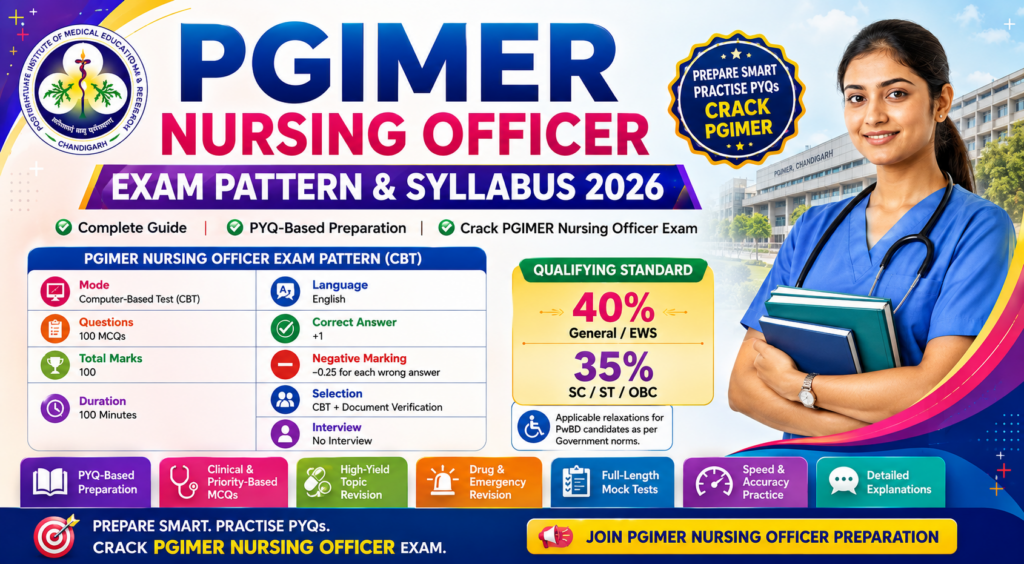
| Mode | Computer-Based Test (CBT) |
| Questions | 100 MCQs |
| Total Marks | 100 |
| Duration | 100 Minutes |
| Language | English |
| Correct Answer | +1 |
| Negative Marking | –0.25 for each wrong answer |
| Selection | CBT + Document Verification |
| Interview | No Interview |
The latest PGIMER recruitment notification states that the CBT consists of 100 objective questions carrying 100 marks, with 0.25 marks deducted for each incorrect answer. Final selection is based on CBT merit after eligibility/document verification.
Qualifying Standard
The 2025 notification specified minimum qualifying marks of 40% for General/EWS and 35% for SC/ST/OBC categories, with applicable provisions for PwBD candidates.
PGIMER Nursing Officer Syllabus
PGIMER specifies that the CBT syllabus is based on the prescribed educational qualification/professional course and relevant experience for the post. Therefore, candidates should prepare the complete GNM/B.Sc. Nursing curriculum rather than relying on a narrow chapter-wise syllabus.
🔴 1. Medical-Surgical Nursing
Highest Priority
- Cardiovascular disorders
- Respiratory disorders
- Neurological disorders
- Diabetes and endocrine disorders
- Renal disorders and dialysis
- Gastrointestinal and liver disorders
- Oncology
- Burns and trauma
- Shock and sepsis
- Critical care
- Perioperative nursing
- Fluid, electrolyte and acid-base balance
- Emergency nursing
🔴 2. Fundamentals of Nursing
- Nursing process
- Nursing assessment
- Vital signs
- Basic nursing procedures
- Infection control
- Hand hygiene and PPE
- Sterilisation and disinfection
- Medication administration
- IV therapy
- Oxygen therapy
- Catheterisation
- NG tube and suctioning
- Pressure injury prevention
- Patient safety
- Documentation
- Therapeutic communication
- Delegation and prioritisation
- BLS/CPR
🔴 3. OBG & Midwifery
- Antenatal care
- High-risk pregnancy
- Pre-eclampsia and eclampsia
- Stages and mechanism of labour
- Partograph
- Fetal monitoring
- PPH
- Placenta previa
- Abruptio placentae
- Obstetric emergencies
- Postnatal care
- Breastfeeding
- APGAR
- Neonatal resuscitation
- Prematurity and LBW
- Contraception
- Common gynaecological disorders
🟠 4. Pediatric Nursing
- Growth and development
- Developmental milestones
- Newborn care
- Prematurity and LBW
- Immunisation
- Neonatal resuscitation
- Neonatal jaundice and sepsis
- Dehydration and diarrhoea
- Respiratory disorders
- Congenital heart disease
- Pediatric emergencies
- IMNCI
🟠 5. Community Health Nursing
- Primary health care
- Epidemiology
- Screening and surveillance
- Immunisation
- Communicable diseases
- TB and HIV/AIDS
- NCDs
- Maternal and child health
- Family planning
- School and occupational health
- Environmental sanitation
- Health education
- National Health Programmes
- Health indicators
- Community assessment
🟠 6. Mental Health / Psychiatric Nursing
- Therapeutic communication
- Mental status examination
- Schizophrenia
- Depression
- Bipolar disorder and mania
- Anxiety disorders
- OCD
- Substance-use disorders
- Alcohol withdrawal
- Suicide prevention
- Psychiatric emergencies
- ECT
- Psychiatric medications
🟡 7. Anatomy, Physiology & Pharmacology
Anatomy & Physiology
Focus on cardiovascular, respiratory, neurological, endocrine, renal and reproductive systems, acid-base balance, electrolytes and normal laboratory values.
Pharmacology
- Drug classifications
- Side effects and contraindications
- Insulin
- Anticoagulants
- Antibiotics
- Antihypertensives
- Diuretics
- CNS drugs
- Emergency drugs
- Antidotes
- Drug calculations
🟢 8. Other Important Areas
Also revise:
- Nutrition & Dietetics
- Microbiology
- Pathology
- Nursing Research
- Nursing Education
- Nursing Administration & Management
- Psychology
- Sociology
- First Aid & Emergency Care
- Professional Trends & Ethics
- Computer Education / Nursing Informatics
Previous PGIMER syllabus resources consistently include these supporting areas along with the major nursing subjects.
What Do Previous PGIMER Trends Suggest?
Available previous-paper resources and syllabus analyses indicate that PGIMER preparation should focus primarily on core nursing subjects, especially:
🔴 Very High Priority
Medical-Surgical Nursing + Fundamentals + OBG
🟠 High Priority
Paediatrics + Community Health + Mental Health
🟡 Moderate Priority
Pharmacology + Anatomy & Physiology + Nursing Administration + Research
The available previous-paper resources also indicate repeated concepts from Fundamentals, OBG and Medical-Surgical Nursing, making PYQ practice particularly important.
PGIMER Nursing Officer Question Style
Candidates should prepare for more than direct factual questions.
Focus on:
🩺 Clinical application
🚨 Priority nursing interventions
💊 Drug & medication safety
📋 Nursing procedures
🧠 Clinical decision-making
⚕️ Emergency management
📊 Normal values and interpretation
For every topic, ask:
“What will the nurse do first?”
“Which patient requires immediate attention?”
“Which finding requires intervention?”
PGIMER Preparation Strategy
1. Complete the Core Nursing Curriculum
Do not restrict preparation to a few high-weightage subjects.
2. Give Maximum Time to
MSN → Fundamentals → OBG → Paediatrics → CHN → Psychiatry
3. Practise Previous-Year Questions
Use PYQs to identify repeated concepts and understand PGIMER’s question style.
4. Practise 100 Questions in 100 Minutes
Speed and accuracy are important because the recent pattern provides approximately one minute per question.
5. Revise Frequently
Focus on:
- Normal values
- Emergency care
- Drugs
- Procedures
- Infection control
- Obstetric emergencies
- Critical care
- Patient safety
Prepare for PGIMER Nursing Officer with Kanika’s Nursing Academy
At Kanika’s Nursing Academy, PGIMER preparation focuses on:
✔️ Complete Nursing Concepts
✔️ PYQ-Based Preparation
✔️ Clinical & Priority-Based MCQs
✔️ High-Yield Topic Revision
✔️ Drug & Emergency Revision
✔️ Full-Length PGIMER Mock Tests
✔️ Detailed Explanations
✔️ Speed & Accuracy Practice
✔️ Rapid Revision Sessions
Prepare Smart. Practise PYQs. Crack PGIMER Nursing Officer Exam.
[JOIN PGIMER NURSING OFFICER PREPARATION]
Disclaimer
This syllabus is a PYQ-based preparation guide prepared by Kanika’s Nursing Academy using the latest available PGIMER recruitment pattern and previous examination trends. PGIMER specifies that the CBT syllabus is based on the prescribed professional qualification/course; therefore, the subject-wise priorities above are indicative and not an official fixed chapter-wise question distribution. Candidates should follow the latest PGIMER recruitment notification for the final examination scheme.
Important official links
Always verify dates, fees, and eligibility on the recruiting organization’s official website.
Get new nursing vacancies in your inbox.
Subscribe once and confirm your email. We will notify you when a new nursing job or examination update is published.